Nuclear Renaissance 2025: Why Uranium Became the Hottest Asset of the Year
Introduction
Imagine: Meta purchases a nuclear power plant for 20 years. Amazon, Google, and other tech giants publicly pledge to triple global nuclear capacity. Sounds like a sci-fi plot? This is the reality of 2025.
While most investors track traditional markets, the nuclear sector shows stunning results: +21% year-to-date versus modest +2% for the S&P 500. What’s happening? Why is everyone suddenly talking about uranium and nuclear energy?
In this detailed analysis, we’ll unpack what’s behind the “Nuclear Renaissance,” which forces are driving the market, and how investors can access this revolution.
1. Three Forces Changing the Game
The investment thesis for the nuclear sector is based on a unique combination of three powerful factors acting simultaneously. This isn’t another speculative boom—it’s a fundamental paradigm shift.
1.1. Fighting Climate Change: Uranium as Clean Baseload
Why it matters: Wind and solar are great, but they don’t work 24/7. When the sun sets and wind dies down, someone needs to keep the lights on. This is called “baseload generation”—and nuclear plants do it perfectly, producing electricity around the clock with zero CO2 emissions.
Impressive numbers:
- According to the International Energy Agency (IEA, January 2025), 63 new reactors are currently under construction worldwide
- That’s over 70 gigawatts of new capacity—the highest figure since the 1990s
- Nuclear energy provides stability for power grids increasingly reliant on intermittent renewable sources
1.2. AI Is Eating Electricity: Big Tech Goes Nuclear
The new player: The most unexpected demand driver is… artificial intelligence. Data centers training models like ChatGPT consume colossal amounts of energy—and they need reliable, high-density power.
Concrete steps by tech giants:
March 2025: Amazon, Google, Meta, and others signed a public pledge to triple global nuclear capacity by 2050
June 2025: Meta signed a historic 20-year agreement with Constellation Energy for 1.1 GW of nuclear power (launch in 2027)
These aren’t PR stunts. These are strategic decisions by companies that understand: without stable energy supply, there’s no future for AI.
1.3. US Policy: Nuclear as National Security
Turning point: In May 2025, President Trump signed four executive orders to revive America’s nuclear industry. This is the most powerful political signal in decades.
Key reform goals:
| Direction | Details |
|---|---|
| Capacity increase | Quadruple growth: from ~100 GW (2024) to 400 GW (2050) |
| Licensing acceleration | Maximum 18 months for new reactors (used to take years!) |
| Independence from Russia | Build domestic uranium conversion and enrichment capacity |
| New technologies | Rapid deployment of Small Modular Reactors (SMRs) |
Why this is revolutionary: Previously, obtaining permits to build nuclear plants could take 5-10 years. Now the government sets strict limits—18 months. This fundamentally changes the economics of new projects.
2. A Deficit That Can’t Be Fixed Quickly
The most important thing to understand about the uranium market: demand is growing much faster than supply can respond. And this isn’t a temporary problem.
2.1. Numbers Don’t Lie
Current situation (2023):
- Global uranium consumption: 75,000 tons
- Global mining production: 53,000 tons
- Deficit: 22,000 tons—equivalent to Kazakhstan’s entire annual production (the world’s largest producer!)
Future outlook:
- By 2040, demand will grow by 30%+, reaching ~100,000 tons per year
- Fastest growth—in China, planning to quadruple its nuclear capacity by 2050
2.2. Why Supply Can’t Keep Up
The main problem—time: From uranium deposit discovery to fully operational mine takes 7-10 years. Even if prices double (which already happened between 2021-2024), new tons of uranium will only hit the market years later.
Where does the “extra” uranium come from now?
- Commercial inventories (limited, running out)
- Reprocessed old fuel (can’t scale)
- Reactivating old deposits (expensive and slow)
Conclusion: This is a classic inelastic supply trap. The market screams “need more!”, but getting a quick physical response—impossible.
3. Geopolitics: Uranium Stopped Being Just a Commodity
If previously uranium was bought wherever it was cheaper, today the question “who’s selling?” became as important as price. Nuclear fuel has become a strategic resource.
3.1. The Russian Trap: Not Just Mining
Common mistake: Many think Russia is important for uranium mining. Actually, it produces only 6% of global uranium. The real dependency is elsewhere.
Where Russia actually dominates:
| Production stage | Russia | North America |
|---|---|---|
| Conversion (ore to gas) | 26% of world | Limited capacity |
| Enrichment (increasing U-235 concentration) | 28.2 million SWU | 4.3 million SWU (US needs 15+ million) |
What’s SWU? Separative Work Unit—a measure of enrichment work. Think of it as “effort amount” to convert natural uranium into reactor fuel. More SWU = more fuel.
Why this is critical: You can have all the ore in the world, but without conversion and enrichment, it’s useless. The US and Europe relied on cheap Russian services for decades—and now it’s a national security threat.
3.2. Kazakhstan: Walking a Tightrope
Context: Kazakhstan produces 43% of global uranium—it’s the absolute leader. But there’s a catch: historically all exports went through Russian territory.
What’s happening now:
- Kazakhstan is developing an alternative “Middle Corridor” via the Caspian and Caucasus (bypassing Russia)
- The route is more expensive and less developed
- The country maneuvers between the West and the Russia-China alliance
Risk for investors: Geopolitical shifts in Kazakhstan can instantly impact Western supplies.
3.3. The West Builds Independence
Concrete actions:
🇺🇸 USA: Russian Uranium Import Ban Act (gradual phase-out by 2027)
🇬🇧 UK: 35% tariff on Russian enriched uranium
🇨🇦 Canada: Complete ban on Russian uranium
What this means: The West is willing to pay more for supply security. Priority shifted from “where’s cheaper” to “who can we trust.”
4. How the Market Responds: Prices and Contracts
Structural deficit and geopolitical tension aren’t abstract concepts. They’re changing market participant behavior right now.
4.1. Price Boom
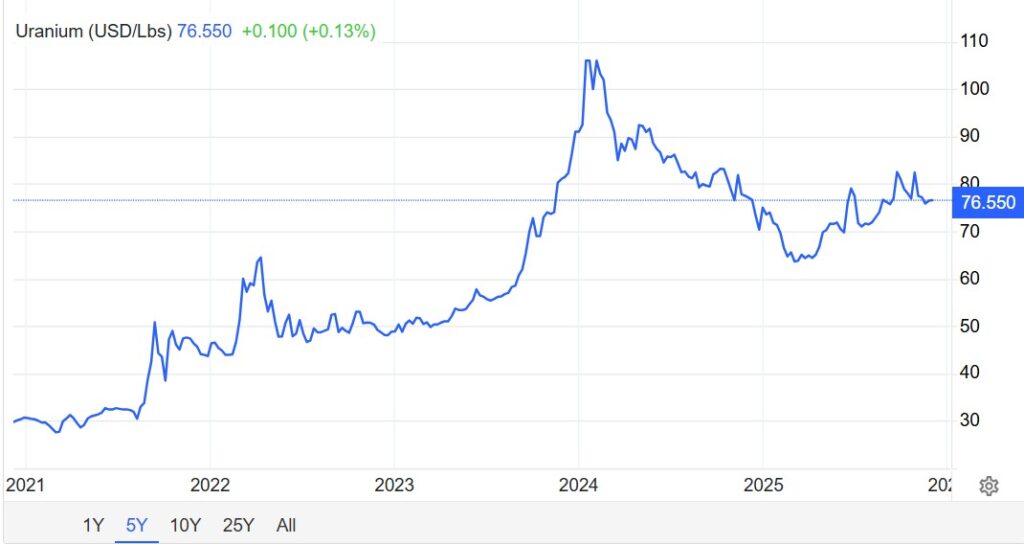
Spot price dynamics: Between 2021 and 2024, uranium prices more than doubled. This isn’t a speculative spike—it’s a fundamental revaluation of a strategic resource.
4.2. Contract Revolution
Old model (pre-2022):
- Short contracts for 3-5 years
- Prices tied to spot market
- Focus on cost minimization
New reality (2025):
- Long-term agreements for 7-10 years
- Fixed prices (security more important than optimization)
- Supplier jurisdiction priority over price
Example: Utilities are willing to pay a 15-20% premium for uranium from “safe” countries (Canada, Australia) instead of cheaper supplies from geopolitically risky regions.
5. The Future: Small Modular Reactors and the HALEU Challenge
5.1. SMRs: Nuclear Energy’s New Format
What are SMRs? Small Modular Reactors—compact nuclear plants that can be factory-produced (like cars) and quickly installed on-site.
Why it matters:
- Lower capital costs
- Faster construction
- Perfect for remote regions and industrial facilities
IEA projections:
- Base scenario: 40 GW of SMR capacity by 2050
- Optimistic: 120 GW (with strong policy support)
5.2. HALEU Challenge: New Dependency
Problem: Many new reactors (including SMRs) require special fuel—HALEU (High-Assay Low-Enriched Uranium).
Current situation:
- Historically, HALEU was produced primarily by… Russia
- Western capacity is almost non-existent
- This creates a new “bottleneck” in the supply chain
Investment opportunity: Companies developing HALEU production in the West have enormous growth potential.
6. How to Invest: ETF Overview
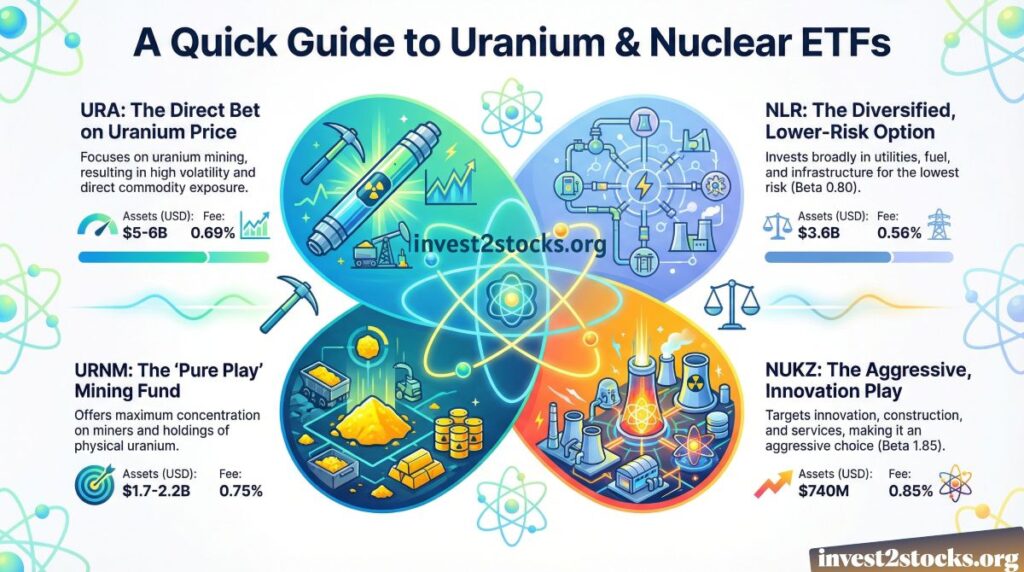
For investors who don’t want to pick individual stocks, Exchange-Traded Funds (ETFs) offer convenient exposure to the nuclear sector. Each fund has its own profile.
Key ETF Comparison
| Ticker | Name | Assets | Fee | Strategy | Top Holdings | Risk |
|---|---|---|---|---|---|---|
| URA | Global X Uranium ETF | $5-6B | 0.69% | Uranium mining | Cameco, Oklo, UEC | High volatility, direct bet on uranium price |
| NLR | VanEck Uranium & Nuclear ETF | $3.6B | 0.56% | Broad: utilities + fuel + infra | Constellation, Cameco, BWX | Diversified, lowest risk (Beta 0.80) |
| NUKZ | Range Nuclear Renaissance ETF | $740M | 0.85% | Innovation, construction, services | Constellation, Silex, Lockheed | Aggressive (Beta 1.85) |
| URNM | Sprott Uranium Miners ETF | $1.7-2.2B | 0.75% | “Pure play” on miners + physical uranium | Kazatomprom, Cameco, Sprott Trust | Maximum uranium concentration |
Beta shows volatility relative to the market: 1.0 = moves like market, 1.85 = moves 85% stronger (both ways)
How to Choose?
Conservative approach: NLR—broadest diversification, lowest volatility
Aggressive uranium bet: URNM or URA—maximum leverage on uranium price
Bet on “Nuclear Renaissance”: NUKZ—focus on innovation and new construction
All these ETFs can be bought on Wealthsimple. Personally, I chose NLR and have already bought it.
7. Conclusion: Three Key Theses
After analyzing all factors, here are three main takeaways for investors:
🔋 Thesis #1: This Isn’t a Cycle, It’s a Supercycle
Previous uranium “bull” markets were based on one or two drivers. Now three powerful forces are playing simultaneously: decarbonization, AI explosion, and energy security. Their combination creates long-term, structural demand for decades ahead.
⚠️ Thesis #2: Main Risk Is Supply, Not Demand
The biggest mistake is worrying about demand falling. The real risk—supply won’t keep up. Structural uranium deficit, exacerbated by geopolitics and critical “bottlenecks” in conversion/enrichment, guarantees price support for years.
🛡️ Thesis #3: Security Is More Expensive Than Price
The market has fundamentally changed. This is no longer a global commodity market where everyone buys from the cheapest. This is a regionalized strategic resource, where supplier jurisdiction weighs more than saving 10-15% on price.
What’s Next?
For investors: The nuclear sector offers a rare combination of structural growth, limited supply, and political support. Should you enter now? It depends on your horizon (minimum 3-5 years) and volatility tolerance.
For citizens: Regardless of investments, nuclear energy is becoming a critical part of our energy future. Understanding these trends will help you navigate news about energy policy and climate change.
Q: Is uranium investment safe in 2025? A: Uranium sector investments have high volatility but are backed by structural deficit and policy support. 3-5+ year horizon recommended.
Q: Which ETF is best for beginners? A: NLR (VanEck) offers the broadest diversification and lowest volatility (Beta 0.80) among uranium ETFs.
Q: Why is Big Tech investing in nuclear? A: AI data centers require reliable 24/7 high-density power that only nuclear plants can provide.
💬 Your Opinion?
We want to hear from you:
- Are you already investing in the nuclear sector? What’s your experience?
- What questions remain unanswered?
- What topics would you like to see in future analyses?
Leave comments below! 👇
⚠️ Disclaimer
This material is for informational purposes only and does not constitute investment advice. Always conduct your own research or consult with a financial advisor before making investment decisions. Investments in the nuclear sector involve high volatility and risks.
Publication Date: December 2025
Sources: IEA, World Nuclear Association, ETF issuers, public reports from Meta/Amazon/Google
Read in Ukrainian > “Ядерний ренесанс 2025: Чому уран став найгарячішим активом року“.